Bhagavad-Gita
 (as-it-is)
Chapter 1
Dhrtarastra said: O Sanjaya, after assembling in the place of pilgrimage at Kuruksetra, what did my sons and the sons of Pandu do, being desirous to fight?
Sanjaya said: O King, after looking over the army gathered by the sons of Pandu, King Duryodhana went to his teacher and began to speak the following words:
O my teacher, behold the great army of the sons of Pandu, so expertly arranged by your intelligent disciple, the son of Drupada. Here in this army there are many heroic bowmen equal in fighting to Bhima and Arjuna; there are also great fighters like Yuyudhana, Virata and Drupada. There are also great, heroic, powerful fighters like Dhrstaketu, Cekitana, Kasiraja, Purujit, Kuntibhoja and Saibya. There are the mighty Yudhamanyu, the very powerful Uttamauja, the son of Subhadra and the sons of Draupadi. All these warriors are great chariot fighters.
O best of the brahmanas, for your information, let me tell you about the captains who are especially qualified to lead my military force. There are personalities like yourself, Bhisma, Karna, Krpa, Asvatthama, Vikarna and the son of Somadatta called Bhurisrava, who are always victorious in battle. There are many other heroes who are prepared to lay down their lives for my sake. All of them are well equipped with different kinds of weapons, and all are experienced in military science.
Our strength is immeasurable, and we are perfectly protected by Grandfather Bhisma, whereas the strength of the Pandavas, carefully protected by Bhima, is limited. Now all of you must give full support to Grandfather Bhisma, standing at your respective strategic points in the phalanx of the army.
Then Bhisma, the great valiant grandsire of the Kuru dynasty, the grandfather of the fighters, blew his conchshell very loudly like the sound of a lion, giving Duryodhana joy. After that, the conchshells, bugles, trumpets, drums and horns were all suddenly sounded, and the combined sound was tumultuous.
On the other side, both Lord Krsna and Arjuna, stationed on a great chariot drawn by white horses, sounded their transcendental conchshells.
Then, Lord Krsna blew His conchshell, called Pancajanya; Arjuna blew his, the Devadatta; and Bhima, the voracious eater and performer of Herculean tasks, blew his terrific conchshell called Paundram. King Yudhisthira, the son of Kunti, blew his conchshell, the Ananta-vijaya, and Nakula and Sahadeva blew the Sughosa and Manipuspaka. That great archer the King of Kasi, the great fighter Sikhandi, Dhrstadyumna, Virata and the unconquerable Satyaki, Drupada, the sons of Draupadi, and the others, O King, such as the son of Subhadra, greatly armed, all blew their respective conchshells.
The blowing of these different conchshells became uproarious, and thus, vibrating both in the sky and on the earth, it shattered the hearts of the sons of Dhrtarastra.
O King, at that time Arjuna, the son of Pandu, who was seated in his chariot, his flag marked with Hanuman, took up his bow and prepared to shoot his arrows, looking at the sons of Dhrtarastra. O King, Arjuna then spoke to Hrsikesa [Krsna] these words: Arjuna said: O infallible one, please draw my chariot between the two armies so that I may see who is present here, who is desirous of fighting, and with whom I must contend in this great battle attempt. Let me see those who have come here to fight, wishing to please the evil-minded son of Dhrtarastra.
Sanjaya said: O descendant of Bharata, being thus addressed by Arjuna, Lord Krsna drew up the fine chariot in the midst of the armies of both parties.
In the presence of Bhisma, Drona and all other chieftains of the world, Hrsikesa, the Lord, said, Just behold, Partha, all the Kurus who are assembled here. There Arjuna could see, within the midst of the armies of both parties, his fathers, grandfathers, teachers, maternal uncles, brothers, sons, grandsons, friends, and also his father-in-law and well-wishers--all present there.
When the son of Kunti, Arjuna, saw all these different grades of friends and relatives, he became overwhelmed with compassion and spoke thus: Arjuna said: My dear Krsna, seeing my friends and relatives present before me in such a fighting spirit, I feel the limbs of my body quivering and my mouth drying up. My whole body is trembling, and my hair is standing on end. My bow Gandiva is slipping from my hand, and my skin is burning. I am now unable to stand here any longer. I am forgetting myself, and my mind is reeling. I foresee only evil, O killer of the Kesi demon. I do not see how any good can come from killing my own kinsmen in this battle, nor can I, my dear Krsna, desire any subsequent victory, kingdom, or happiness.
O Govinda, of what avail to us are kingdoms, happiness or even life itself when all those for whom we may desire them are now arrayed in this battlefield? O Madhusudana, when teachers, fathers, sons, grandfathers, maternal uncles, fathers-in-law, grandsons, brothers-in-law and all relatives are ready to give up their lives and properties and are standing before me, then why should I wish to kill them, though I may survive? O maintainer of all creatures, I am not prepared to fight with them even in exchange for the three worlds, let alone this earth. Sin will overcome us if we slay such aggressors. Therefore it is not proper for us to kill the sons of Dhrtarastra and our friends. What should we gain, O Krsna, husband of the goddess of fortune, and how could we be happy by killing our own kinsmen? O Janardana, although these men, overtaken by greed, see no fault in killing one's family or quarreling with friends, why should we, with knowledge of the sin, engage in these acts? With the destruction of dynasty, the eternal family tradition is vanquished, and thus the rest of the family becomes involved in irreligious practice.
When irreligion is prominent in the family, O Krsna, the women of the family become corrupt, and from the degradation of womanhood, O descendant of Vrsni, comes unwanted progeny. When there is increase of unwanted population, a hellish situation is created both for the family and for those who destroy the family tradition. In such corrupt families, there is no offering of oblations of food and water to the ancestors. Due to the evil deeds of the destroyers of family tradition, all kinds of community projects and family welfare activities are devastated.
O Krsna, maintainer of the people, I have heard by disciplic succession that those who destroy family traditions dwell always in hell. Alas, how strange it is that we are preparing to commit greatly sinful acts, driven by the desire to enjoy royal happiness.I would consider it better for the sons of Dhrtarastra to kill me unarmed and unresisting, rather than to fight with them. Sanjaya said: Arjuna, having thus spoken on the battlefield, cast aside his bow and arrows and sat down on the chariot, his mind overwhelmed with grief.
End of Chapter 1
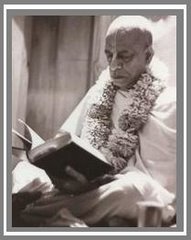
Translated from original sanskrit by AC Bhaktivedanta Swami Maharaj


 "Temporary duties are short lived. The soul's temporary duties are not performed in all situations and all times. For example: a brahmana's brahmana nature, a ksatriya's ksatriya nature, and other like natures also, are manifested because of a particular cause. When the cause ceases to be, these natures vanish. A person may in one birth be a brahmana and in the next birth an outcaste. Therefore the duties of the brahmana caste are temporary. They are not the original duties of the soul. Therefore in reference to temporary duties the phrase 'own duty' is only a figure of speech. That is why in every birth a soul's 'own duty'changes. However, in none of these births does the soul's eternal duty ( Sanatana Dharma ) ever change. This eternal duty is the soul's true 'own duty'. Temporary duties are all short lived.