According to Darwinists, the ancestors of modern humans migrated out of Africa and colonized Asia and Europe. When North of Europe and Asia became ice free the Caucasus region was the route used. Immediately to the south of the Caucasus, the Euphrates and the Tigris have their sources.
According to Jews, Moslems and Christians this is where the garden of Eden was located and is the homeland of Abraham. Mount Ararat in the South Caucasus was the mountain where Noah's ark landed. This is the supposed homeland fatherland of the Indo-European Caucasians.
Vedic View:Atri is another of Brahma's sons. Atri's son was Soma or Candra (the demigod who governs the moon). Candra's son was Budha (not the one from the Buddhists), the king of the planet Mercury. one of Buddha's sons was Pururava. Then the descent goes through Ayu, then Nahusa and then Yayati. Yayati had five sons: Yadu gave rise to the Yadu-dynasty, in which Krishna and Balarama appeared; Puru gave rise to the Puru-dynasty in which Bhisma, Dhrtarastra, Arjuna, Yudhisthira, Bhima, Duryodhana and Maharaja Pariksit were born. Puru received the land of Egypt. Puru's son was Pravira. His son was Manasyu (yu = the uniter) also called Menes, who according to Western historians founded Egypt's first dynasty. The name Paurava's, Puru's descendants later degenerated to Pharaoh's. Yadu and the other sons of Yayati were subordinate to Puru.
Eventually, the Yadu clans who had settled in Egypt left Egypt where they were persecuted. Out of this clan came the Jews.Egypt is named after Ajapati, the son of the Aja clan. Aja was the grandfather of Lord Sri Ramacandra. Ramacandra is an expansion of Lord Sri Krishna. Sri Ramacandra appeared in the Surya-vamsa (family) of Vivasvan and Vivasvata Manu. Another name for Suryadeva is Ravi. Ra became the highest God, the father of this branch of the Surya-vamsa in Egypt. Their kings were Ramses, for them Rama-isa (Rama, the Lord) was God. Siva or (Maha)-isvara, the controller of the material world became Osiris.
Some members of the Pandava-family also came to Egypt and Europe, after Dvaraka, Krishna's residence, disappeared. The pyramids design was based on the smashana-cit-altars for the Vedic cremation rituals. The positions of the different parts of the building reflect the positions of the stars and the apex points to the devaloka's, the heavenly planets. They also moved to iswara (=God) laya (=land) or Israel. From the Essenes (worshippers of isa, Siva) came Jesus (= of Isa) Christus (= of Krishna). Yajati's three other rebellious sons received kingdoms outside of India. Yavana or Turvasu got Turkey, Persia etc.
According to the Mahabharata (Adi Parva 85.34) Turvasu fought for Duryodhana on the battlefield of Kuruksetra. Anu got Greek and Italy. Another migration of groups of people was started by Parasurama (also a descendant of Pururava) who displaced a branch of the Yadu's, the demonic Haihaya kings and their followers, who settled mainly in Egypt. They became kings there. Some came to Europe and Asia.About 4000BC Druhyu, the fifth son of Yayati, was banished to Europe. From Druhyu came the Druids, also connected with the Dravids, followers of the wise (=vid) man Drastha. Some barbarian tribes descended from him (more or less ksatriya's). They settled themselves in France and England. Around the same time the Saxenas, a demonic ksatriya clan, were banished from India. These were the Saxons who settled in Western-Europe. After the battle of Kuruksetra in 3138 B.C., the worldwide system of varnasramadharma, or the Vedic social-political system slowly degraded.
The Vedic culture was more or less present everywhere, but mainly in India. Civilized nations search for nice places like the tropics to settle. Patalabhumi (the hellish or low land), the western hemisphere, mainly the north, were avoided.Around 2000 B.C. different groups of Indian Indo-europeans went to the west. Also in the past groups went to the west to teach (like a group sharmans, brahmanical scholars, later called the Germans) and to reign (to establish the varnasramadharma-system). Or to emigrate because the river Sarasvati was dried up. Also some were banned because they had left the Vedic lifestyle. In 1103 B.C. the Trojans became the Sumeric Indo-europeans (because of the increasing desert because the river Saraswati dried up). In 800 B.C. the Kalatoya's came from the area to the south of Kashmir. These were the Kelts. In 2000 B.C. they left India when the river Saraswati dried up. In 1000 B.C. they arrived at the Danube (the river which flows through the land of the Danavas or demons). The people of Alinas (Hellenes) was one of the first groups to emigrate from India (to Greece).
According to the Mahabharata (Adiparva 174.38) Bhima and Sahadeva conquered the Pulinda's (Greeks) because they had given up dharma.The name Norway is derived from the Sanskrit naraka or hel. Soviet from sveta (white), Russia from rushis or rsi's, wise men who meditated there. Siberia from the Sanskrit word for inhospitable, camping site. Scandinavia from skandha, the commander in chief of the demigods. They navigated in the name of Skandha and worshipped Skandha. The words viking and king are from the sanskrit singh (lion). The Vikings were great white-haired daityas. The name 'Alps' is derived from alpa (small in comparison with the Himalaya's). At many places in Europe murti's (statues) of Krishna, Shiva (linga), Mitra (sungod) and so on have been found.
According to the purana's, the history-books of the Veda and the upapurana's (smaller purana's) around 11,000 B.C., there were floods, at the end of the glacial age. Thanks to their boat, Vaivasvata Manu (Noah) and his family, were virtually the only survivors. Following twelve great wars between the deva's (godly people) and the asura's (godless people), the land to the east of the Caucasus was given to the deva's and that to the west of the Caucasus was given to the asura's.Some asura's were (under Mayadanava, also a son of Kasyapa Muni - from Kasyapa's wife Danu) banished to South America, Patalabhumi/loka, or the land under (and to the opposite of) Punya-bhumi. There, Mayadanava is the engineer and the king of the Danava's. His fixed homelad is talatala-loka (1.088.000 km to the south of the Bhumandala) where the flying saucers are made. The maya's, the followers of Mayadanava, called their land Amaraka (amara = immortal, amrita=nectar). Asura's often think that death is something that will not happen to them and they think their mother land is paradise. Later Amerigo Vespucci could recover the name via his name America.
For more detailed information and discussion see the book Proof of Vedic Culture's Global Existence from Nandanandana dasa - Stephen Knapp).
Sunday, July 29, 2007
Links Between Ancient India and the Mayans
Recent studies hint at possible links between the ancient civilization of the Indus valley and the Mayans of central America.
B G Siddarth, the director of the B M Birla science centre in Hyderabad, had pointed out striking similarities between the two ancient cultures. Mexico and India are situated at opposite sides of the earth in longitude. According to the Puranas, a secondary Hindu scripture, the "devas" or the gods and the demons or the "assures" lived on the opposite sides of the Earth. The experts took a deep interest in the calendars followed by the two cultures. While the Indus valley people followed a calendar based on the movements of the Jupiter, acknowledged to be the leader of the gods, the Mayans followed one based on the movements of Venus or "Shukra", who, according to the Puranas, was the leader of the ashuras. Siddharth also pointed out that some carvings in Mexico depicted an episode similar to that of churning the ocean by the gods and the demons in the Hindu mythology. The Mexican representations of the tradition also bore a striking resemblance to those found in different parts of India. Dr Ganpati, an expert on the ancient Hindu architecture, based in Chennnai had also found striking similarities between the design and the construction methods used by the Mayans and the ancient Hindus.
B G Siddarth, the director of the B M Birla science centre in Hyderabad, had pointed out striking similarities between the two ancient cultures. Mexico and India are situated at opposite sides of the earth in longitude. According to the Puranas, a secondary Hindu scripture, the "devas" or the gods and the demons or the "assures" lived on the opposite sides of the Earth. The experts took a deep interest in the calendars followed by the two cultures. While the Indus valley people followed a calendar based on the movements of the Jupiter, acknowledged to be the leader of the gods, the Mayans followed one based on the movements of Venus or "Shukra", who, according to the Puranas, was the leader of the ashuras. Siddharth also pointed out that some carvings in Mexico depicted an episode similar to that of churning the ocean by the gods and the demons in the Hindu mythology. The Mexican representations of the tradition also bore a striking resemblance to those found in different parts of India. Dr Ganpati, an expert on the ancient Hindu architecture, based in Chennnai had also found striking similarities between the design and the construction methods used by the Mayans and the ancient Hindus.

Saturday, July 28, 2007
A question and an answer
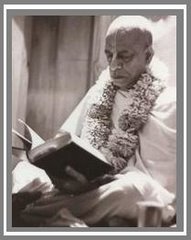
Q. Why do you refer to A.C Bhaktivedanta Swami as "A.C Bhaktivedanta Swami Maharaj" ?
A. He was given the name Swami Maharaj when he entered the sannyasa ashram (the renounce order). He had already been awarded the title Bhaktivedanta so when Abhaya Charan De took sannyasa his name then became A.C Bhaktivedanta Swami Maharaj.
A. He was given the name Swami Maharaj when he entered the sannyasa ashram (the renounce order). He had already been awarded the title Bhaktivedanta so when Abhaya Charan De took sannyasa his name then became A.C Bhaktivedanta Swami Maharaj.
Friday, July 27, 2007
Stop Animal Killing

Sri Caitanya explained what follows in great detail to all the residents of Varnasi, who then after hearing attentively became Vaisnava devotees. At the time Varnasi was a transcendental HUB where learned pundits representing all branches of knowledge used to live and teach.
 Śrīpāda Śankarācārya’s propaganda opposed the atheistic philosophy of Buddha.
Lord Buddha’s intention was to stop atheists from committing the sin of killing animals. Atheists cannot understand God; therefore Lord Buddha appeared and spread the philosophy of nonviolence to keep the atheists from killing animals. Unless one is free from the sin of animal-killing, he cannot understand religion or God.

Although Lord Buddha was an incarnation of Kṛṣṇa, he did not speak about God, for the people were unable to understand. He simply wanted to stop animal-killing.
Śrīpāda Śankarācārya wanted to establish the predominance of one’s spiritual identity; therefore he wanted to convert the atheists through an imaginary interpretation of the Vedic literatures. These are the secrets of the ācāryas. Sometimes they conceal the real purpose of the Vedas and explain the Vedas in a different way. Sometimes they enunciate a different theory just to bring the atheists under their control. Thus it is said that Śankara’s philosophy is for pāṣaṇḍas, atheists.
 Śrīpāda Śankarācārya’s propaganda opposed the atheistic philosophy of Buddha.
Lord Buddha’s intention was to stop atheists from committing the sin of killing animals. Atheists cannot understand God; therefore Lord Buddha appeared and spread the philosophy of nonviolence to keep the atheists from killing animals. Unless one is free from the sin of animal-killing, he cannot understand religion or God.
Although Lord Buddha was an incarnation of Kṛṣṇa, he did not speak about God, for the people were unable to understand. He simply wanted to stop animal-killing.
Śrīpāda Śankarācārya wanted to establish the predominance of one’s spiritual identity; therefore he wanted to convert the atheists through an imaginary interpretation of the Vedic literatures. These are the secrets of the ācāryas. Sometimes they conceal the real purpose of the Vedas and explain the Vedas in a different way. Sometimes they enunciate a different theory just to bring the atheists under their control. Thus it is said that Śankara’s philosophy is for pāṣaṇḍas, atheists.
Sri Caitanya Caritamrta Chapter 25 text 42
Break her backbone
It was February 1835, a time when the British were striving to take control of the whole of India. Lord Macaulay, a historian and a politician, made a historical speech in the British Parliament, commonly referred to as The Minutes, which struck a blow at the centuries old system of Indian education.
His words were to this effect: I have traveled across the length and breadth of India and I have not seen one person who is a beggar, who is a thief. Such wealth I have seen in this country, such high moral values, people of such calibre, that I do not think we would ever conquer this country, unless we break the very backbone of this nation, which is her spiritual and cultural heritage, and, therefore, I propose that we replace her old and ancient education system, her culture, for if the Indians think that all that is foreign and English is good and greater than their own, they will lose their self-esteem, their native self-culture and they will become what we want them, a truly dominated nation.
Reproduced in Niti issue of April, 2002 at p. 10 - a periodic publication of Bharat Vikas Parishad, Delhi.
His words were to this effect: I have traveled across the length and breadth of India and I have not seen one person who is a beggar, who is a thief. Such wealth I have seen in this country, such high moral values, people of such calibre, that I do not think we would ever conquer this country, unless we break the very backbone of this nation, which is her spiritual and cultural heritage, and, therefore, I propose that we replace her old and ancient education system, her culture, for if the Indians think that all that is foreign and English is good and greater than their own, they will lose their self-esteem, their native self-culture and they will become what we want them, a truly dominated nation.
Reproduced in Niti issue of April, 2002 at p. 10 - a periodic publication of Bharat Vikas Parishad, Delhi.
Wednesday, July 25, 2007

Conch-shells

 Bhagavad - Gita 1.19
The blowing of these different conch-shells became uproarious. Vibrating both in the sky and on the earth, it shattered the hearts of the sons of Dhritarastra.
Purport
When Bhisma and the others on the side of Duryodhana blew their respective conch-shells, there was no heart-breaking on the part of the Pandavas. Such occurrences are not mentioned, but in this particular verse it is mentioned that the hearts of the sons of Dhritarastra were shattered by the sounds vibrated by the Pandavas’ party. This is due to the Pandavas and their confidence in Lord Krishna. One who takes shelter of the Supreme Lord has nothing to fear, even in the midst of the greatest calamity.
- A.C Bhaktivedanta Swami Maharaj
Subscribe to:
Posts (Atom)