Friday, August 1, 2008

On August 1, 2008, a total solar eclipse will occur as the new moon moves directly between the sun and the earth. The moon’s umbral shadow will fall on parts of Canada, Greenland, the Arctic Ocean, Russia, Mongolia, and China.
-----------------------------------------------------------
Vedic astronomers of five thousand years ago could predict eclipses of the sun and moon just as well as our modern astronomers can. The knowledge of the ancient astronomers went much further, however, since they understood the karmic influences of such events. Solar and lunar eclipses are generally very inauspicious, with certain rare exceptions. But just as the otherwise inauspicious Ekadasi day becomes beneficial when used for the glorification of Lord Hari, so the time of an eclipse is also advantageous for fasting and worship.

It is customary in Bharat Varsa ( India ) that all the followers of the Vedic scriptures bathe in the Ganges or the sea as soon as there is a lunar or solar eclipse. All strict followers of the Vedic religion stand up in the water throughout the whole period of the eclipse and chant the Hare Krishna maha-mantra.

Kurukshetra is a fact, and it is a dharmaksetra. Still many millions of devotees go there to visit, especially during the solar eclipse. And when Krishna was staying on this planet He, His brother Balarama, and His sister Subhadra also visited Kurukshetra. That ceremony is observed as Ratha-yatra. ........ACBSP

Thursday, July 31, 2008


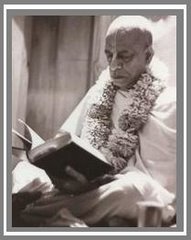
Srila Bhakti Raksak Sridhara Deva-Goswami Maharaja
and associates
------------------------------------------------------------------------

Whenever there is any difference in the spiritual advice we may receive from different directions, we are to see the common thread. However, the absolute position will warrant a higher consideration than the relative one. Both the absolute and relative considerations must continue, because without that, no progress is possible.


Absolute and relative - both considerations must go side by side. But the absolute has the primary position, and the relative, the temporary, shall be evaluated according to what is suitable to the particular time, place, person, and purpose. So in this, the longest journey of our lives, and for our greatest interest, we are given the truth, the connection of the Absolute, always - and there is unity.

Even in the case of an ordinary Guru of lower type, the sastra has also maintained that link: paroksa-vada vedo 'yam. If a certain standard of self-discipline such as no meat or fish-eating, etc. is demanded of those who are very much conditioned by lower propensities, then they won't come into the fold; but the policy is that they must come, so some allowances are given. For a particular type of disciple there will be a corresponding Guru and a similar sastra, but it is with the hope that they will take up the path of progress. The sastras are so generous in going to the lowest section, and the corresponding Guru will also be there. Similar Guru, similar sastra, and similar sadhu - all are extended to the lowest plane to elevate the conditioned souls by a gradual process.

And the sastra also has got in its mind that in this gradual process some provision must be given, otherwise a great many will give it up. That universal mind is there, and that sort of consciousness is in the minds of the rsis who have prepared those sastras, and in the corresponding Gurus as well.


The sadhus and sastras are going to the extremity of the sinful area, because otherwise there would be no chance for anyone to rise from that level. But generally the disciples, the sadhakas, will take up spiritual practices from their own plane - their own level of realization or inner evolution - they'll go up from there, and along the way also they will find the appropriate Guru and sastra.

It is just like this: our sight is within a particular spectrum - we can't see very much intense light, nor very meager light either. The same with sound; we can't hear very high frequency sound, nor very low. So we are working in the relative position.


But we are told to stick to the absolute thread continually in order to properly understand the whole. Therefore don't undermine the Acarya. Although you may be seeing some ordinary characteristics there - eating, sleeping - don't undermine him! Otherwise you'll be the loser. Just as in the Ganges water, we are not to take notice of the stones, the wood, the foam; Ganges water can purify everything.


What is it that can purify? Its water aspect? No.


There is another aspect, and if that is analyzed, ultimately we will see the order of the Lord: it is His order that Ganges water will purify. So the purifying power comes from His will; His will is backing that. We shall try to find the absolute backing everywhere; and if we can't sacrifice the relative position, then we'll have to go to the plane of nirvisesa (the undifferentiated aspect of the absolute in which service is absent).

There is a complete system which comprises Krsna and His Associates of different types, and we want to have our connection with both Sakti (the Potency) and Saktiman (the Possessor of Potency). We can never sacrifice either of Them, especially Sakti. For example, when Raghunatha Das Goswami says, "I do not want Krsna if Radharani is not there; rather, I want Radharani," then who is Radharani? Who is She? She is the one who is full of Krsna to the greatest degree, so Das Goswami says, "I want Radharani." Krsna is there, and in different relative positions He comes to each particular person as sweet, sweeter, sweetest. In this way, we find such relativity.

Olympic link to early 'computer'

This device is a unique piece of ancient technology

A 2,100-year-old "computer" found in a Roman shipwreck may have acted as a calendar for the Olympic Games, scientists report in Nature journal.

The Antikythera Mechanism has puzzled experts since its discovery by Greek sponge divers in 1901.

Researchers have long suspected the ancient clockwork device was used to display astronomical cycles. A team has now found that one of the dials records the dates of the ancient Olympiad. This could have been to provide a benchmark for the passage of time.

The device is made up of bronze gearwheels and dials, and scientists know of nothing like it until at least 1,000 years later.

Social importance
Tony Freeth, a member of the Antikythera Mechanism Research Project, said he was "astonished" at the discovery. "The Olympiad cycle was a very simple, four-year cycle and you don't need a sophisticated instrument like this to calculate it. It took us by huge surprise when we saw this. " But the Games were of such cultural and social importance that it's not unnatural to have it in the Mechanism."

The technique of X-ray computed tomography gave the researchers a 3D view of its 29 surviving gears. High-resolution imaging provided them with a close-up of tiny letters engraved on the surface.

The device's "subsidiary dial" was once thought to be a 76-year "callippic" calendar. However, Mr Freeth and his colleagues have now been able to establish from its inscriptions that it displays the 4-year Olympiad cycle.

Instead of one Olympics as there is today, the ancient Olympiads, called the Panhellenic Games, comprised four games spread over four years.

The four sectors of the dial are inscribed with a year number and two Panhellenic Games: the "crown" games of Isthmia, Olympia, Nemea and Pythia; and two lesser games: Naa (held at Dodona) and a second game which has not yet been deciphered. In addition, the team was able to identify the names of all 12 months, which belong to the Corinthian family of months.

Corinth, in central Greece, established colonies in north-western Greece, Corfu and Sicily, where Archimedes was established.

Archimedes, whose list of exploits included an explanation for the displacement of water and a screw pump that bears his name today, died there in 212 BC.

The Antikythera Mechanism was "almost certainly made many decades" after his death, according to Alexander Jones, a professor at the Institute for the Study of the Ancient World in New York, US. If it came from Syracuse, the dial could have been made by the school of scientists and instrument-makers he inspired.

The priceless artifact was found by a sponge diver amid other treasures on a wreck near the tiny island of Antikythera between Crete and the mainland. It is on display at the National Archaeological Museum in Athens.


Commentary by AJD

The reason I find this clip interesting is because even after "discovery" of so many sophisticated artifacts the so-called intellectual community of today honestly still do not fully accept that former civilizations were highly developed. The Veda contains all departments of detailed knowledge of Soul Science, Mundane Science, Architecture, Medicine, Astrology, Military arts, Civics, Diplomacy etc. Intellectuals, Scholars, Leaders of todays Societies as well as people in general could learn many things if they would just take the time to hear it, instead of oohing and awing over little unexplained miracles when accidentally discovered.

Tuesday, July 29, 2008

Gopala = The Guardian of the Cows and Calf's

The Sound of Gopal's Venu (flute) would enter the ear holes of the cows and calf's, upon hearing that flute song they would feel great transcendental happiness and would sometimes stop in their tracks showing ecstatic symptoms like being stunned and momentarily becoming like immovable objects.

Sunday, July 27, 2008

Vrindavan -- Gaudiya -- timeline
  • 1473 Appearance of Lord Nityananda.

  • 1479 Madhavendra Puri visits Radha-kunda and Govardhana -establishes worship of Gopala later known as Sri Nathaji

  • 1482 Advaita Acarya takes diksa in Vrindavana from Madhavendra Puri

  • 1483 Appearance of Lokanatha Gosvami

  • 1486 Appearance of Lord Caitanya

  • 1487 Appearance of Gadadhara Pandita

  • 1488 Appearance of Sanatana Gosvami

  • 1489 Appearance of Rupa Gosvami

  • 1491 Disappearance of Madhavendra Puri

  • 1491 Vishvarüpa takes sannyasa

  • 1494 Appearance of Raghunatha dasa Gosvami

  • 1496 Appearance of Krsna dasa Kaviraja Gosvami

  • 1503 Appearance of Gopala Bhatta Gosvami

  • 1505 Appearance of Raghunatha Bhatta Gosvami

  • 1508 Lokanatha Gosvami and Bhurgarba Gosvami come to Vrindavana

  • 1510 Lord Caitanya takes sannyasa.

  • 1513 Appearance of Jiva Gosvami.

  • 1515 Lord Caitanya visits Vrndavana.

  • 1516 Rupa and Sanatana come to Vrndavana.

  • 1516 Prabhodananda Sarasvati Gosvami comes to Vrindavana.

  • 1531 Raghunatha dasa Gosvami comes to Vrndavana.

  • 1534 Lord Caitanya's disappearance.

  • 1534 Appearance of Narottama dasa Thakura.

  • 1535 Jiva Gosvami comes to Vrindavana.

  • 1541 Disappearance of Lord Nityananda.

  • 1541 Completion of Bhakti-rasamrita-sindhu by Rupa Gosvami

  • 1542 Installation of Radha-Damodara in Vrindavana.

  • 1542 Installation of Radharamana in Vrindavana.

  • 1545 Jiva Gosvami purchases the land at Radha-Kunda.

  • 1545 Raghunatha dasa Gosvami starts excavation of Radha-Kunda and Syama-Kunda

  • 1550 Disappearance of Advaita Acarya.

  • 1554 Completion of Radha-Kunda and Syama-Kunda.

  • 1558 Disappearance of Sanatana Gosvami

  • 1564 Disappearance of Rupa Gosvami

  • 1570 Emperor Akbar, the great meets Jiva Gosvami in Vrindavana

  • 1571 Disappearance of Raghunatha dasa Gosvami

  • 1575 Completion of Caitanya-Bhagavata by Vrindavana dasa Thakura

  • 1578 Disappearance of Gopala Bhatta Gosvami

  • 1579 Disappearance of Raghunatha Bhatta Gosvami

  • 1580 Temple at Madana-Mohana opens at Vrindavana.

  • 1581 Krsnadasa Kaviraja Gosvami completes Caitanya Caritamrita

  • 1582 Disappearance of Krsna dasa Kaviraja Gosvami

  • 1585 Disappearance of Lokanatha Gosvami

  • 1590 Govindaji Mandira opens in Vrindavana.

  • 1608 Disappearance of Jiva Gosvami

  • 1611 Disappearance of Narottama dasa Thakura.

  • 1630 Disappearance of Syamananda Pandita Gosvami

  • 1638 Appearance of Visvanatha Cakravarti Thakura.

  • 1708 Disappearance of Visvanatha Cakravarti Thakura.

  • 1838 Appearance of Bhaktivinoda Thakura.

  • 1874 Appearance of Bhaktisiddhanta Sarasvati Gosvami
  • 1895 Appearance of Bhakti Raksaka Sridhara Maharaj
  • 1896 Appearance of His Divine Grace A.C. Bhaktivedanta Swami Prabhupada

  • 1914 Disappearance of Bhaktivinoda Thakura.

  • 1933 Bhaktivedanta Swami initiated by Srila Bhaktisiddhanta Sarasvati

  • 1936 Disappearance of Srila Bhaktisiddhanta Sarasvati Gosvami

  • 1959 Bhaktivedanta Swami Prabhupada takes sannyasa.

  • 1965 Bhaktivedanta Swami Prabhupada sails to America.
  • 1968 Disappearance of Bhaktiprajnana Kesava Maharaja
  • 1975 Krsna-Balarama Mandira opens in Vrindavana.

  • 1977 Disappearance of His Divine Grace A.C.Bhaktivedanta Swami Prabhupada
  • 1988 Disappearance of Bkakti Raksaka Sridhara Maharaj

Wednesday, July 23, 2008

Genius

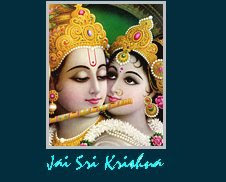
A person is called a genius when he can refute any kind of opposing element with newer and newer arguments. In this connection there is a statement in Padyāvalī which contains the following conversation between Kṛṣṇa and Rādhā. One morning, when Kṛṣṇa came to Rādhā, Rādhā asked Him, "My dear Keśava, where is Your vāsa at present?" The Sanskrit word vāsa has three meanings: one meaning is residence, one meaning is fragrance, and another meaning is dress.

Actually Rādhārāṇī inquired from Kṛṣṇa, "Where is Your dress?" But Kṛṣṇa took the meaning as residence, and He replied to Rādhārāṇī, "My dear captivated one, at the present moment My residence is in Your beautiful eyes."
To this Rādhārāṇī replied, "My dear cunning boy, I did not ask You about Your residence. I inquired about Your dress."

Kṛṣṇa then took the meaning of vāsa as fragrance and said, "My dear fortunate one, I have just assumed this fragrance in order to be associated with Your body."

Śrīmatī Rādhārāṇī again inquired from Kṛṣṇa, "Where did You pass Your night?" The exact Sanskrit word used in this connection was yāminyāmuṣitaḥ. Yāminyām means "at night," and uṣitaḥ means "pass." Kṛṣṇa, however, divided the word yāminyāmuṣitaḥ into two separate words, namely yāminyā and muṣitaḥ. By dividing this word into two, it came out to mean that He was kidnapped by Yāminī, or night. Kṛṣṇa therefore replied to Rādhārāṇī, "My dear Rādhārāṇī, is it possible that night can kidnap Me?" In this way He was answering all of the questions of Rādhārāṇī so cunningly that He gladdened this dearest of the gopīs.

Nectar of Devotion , Chapter 21, Qualities of Sri Krishna

Tuesday, July 22, 2008

“Sometimes that playful Krishna would hide in the water of the Yamuna and place his face among a cluster of lotuses so no one could recognize him.”

“When Krishna’s friends, whose lives depended on seeing him, couldn’t find him anywhere, they became terribly distressed and afraid and began to cry and call out desperately to him.”

“Then, emerging with a big smile from the cluster of lotuses, he happily reunited with his wide-eyed, leaping friends and eagerly began to play.”

Brhad-Bhagavatamrtam 2.7.48/50