Sunday, July 13, 2008

By my desire


Vrajendra Nandana Bhaje Jei Jana
by
Locana Das Thakura
1445-1540

LYRICS:
(1)
vrajendra-nandana, bhaje jei jana, saphala jīvana tā’ra,
tāhāra upamā, vede nāhi sīmā, tri-bhuvane nāhi āra

(2)
emana mādhava, nā bhaje mānava, kakhana mariyā jābe,
sei se adhama, prahāriyā yama, raurave kṛmite khābe

(3)
tā’ra-para āra, pāpī nāhi chāra, saḿsāra jagat-mājhe,
kona kāle tā’ra, gati nāhi āra, michāi bhramiche kāje

(4)
śrī locana dāsa, bhakatira āśa, hari-guṇa kahi likhi,
hena rasa-sāra, mati nāhi jā’ra, tā’ra mukha nāhi dekhi

TRANSLATION


1) That person who worships Vrajendra-nandana makes his life successful. In the three worlds there is none equal to Him. The Vedas cannot completely describe His glories.

2) Whoever fails to worship that Sri Madhava is taken to Yamaraja after death and put in the hell called Raurava-loka (where he is eaten alive by worms and insects). There is no one as sinful as him.

3) Since there is no greater sinner than he throughout the universe, he cannot be delivered at any time but continues to wander, performing temporary materialistic activities that result in suffering.

4) Sri Locana dasa states, "Only by my desire to obtain bhakti am I able to describe Sri Hari’s qualities. I never wish to see the face of that person whose intelligence is not fixed on Vrajendra-nandana, the very essence and embodiment of all rasa.

Saturday, July 12, 2008

Rath yatra celebrated July 4th 2008 in Puri, Orissa

Also known as the Car festival, this spectacular chariot festival is celebrated in the month of Asadha, on the second day of the lunar fortnight that falls during June-July. Popularly known as Rathyatra, this festival is celebrated in the honor of Lord Jagannath who is an incarnation of Lord Vishnu.

The celebrated Ratha-Yatra festival started in the time of Svarochisha Manu of the second manvantara and is predicted to continue until the end of the second half of Lord Brahma's lifetime.

In the Valmiki Ramayana, it is said that when Lord Rama was getting ready to leave this world; he told Vibhishan, Ravana's younger brother to worship Lord Jagannatha, the Lord of the Iksvaku dynasty in His absence.

The Skanda Purana also fixes the date of the Ratha-Yatra as the second day of the bright fortnight if the month of Ashadha, a day called Pushyami Nakshatra by astrological calculations.

The Padma Purana describes that in Purushottama-kshetra, or Jagannatha Puri, the supremely blissful Personality of Godhead pretends to be made of wood. In this way, although the Lord takes on what appears to be a material form, it is completely spiritual by the causeless mercy of the Lord for the conditioned souls who cannot perceive the transcendental domain of His.

On the day of the festival the wooden images of Krishna, Balrama and Subhadra are taken out in procession in three chariots to their summer temple for a week. The main chariot is 14 meters high and 10 meters square with 16 wheels. The actual construction of the carts begins two months before the festival day, on the third day of the bright fortnight of Vaisakha (April-May). More than 600 trees, or 400 cubic meters of wood, are needed for the construction, taken from the local forests along the banks of the Mahanadi River. Using the same simple tools and procedures as they have for the past hundreds of years, once the basic elements are made, such as the wheels, the actual construction begins only a few weeks before the festival.The ropes of the huge chariots are pulled by millions of devotees.

Since Sri Jagannath is a form of Vishnu and Sri Krishna, many of the rituals observed in Puri temple are associated with events in the life of Sri Krishna.

Friday, July 11, 2008

"I offer my respectful obeisances to the Supreme Absolute Truth, Krishna, who is the well-wisher of the cows and the brahmanas as well as all living entities in general. I offer my repeated obeisances to Govinda, who is the pleasure reservoir for all the senses." - Visnu Purana 1.19.65
The followers of Sri Caitanya Mahaprabhu are described

Monday, July 7, 2008

Rejecting all religious activities


Completely rejecting all religious activities which are materially motivated, this Bhagavata Purana propounds the highest truth, which is understandable by those devotees who are fully pure in heart. The highest truth is reality distinguished from illusion for the welfare of all. Such truth uproots the threefold miseries. This beautiful Bhagavatam, compiled by the great sage Vyäsadeva [in his maturity], is sufficient in itself for God realization. What is the need of any other scripture? As soon as one attentively and submissively hears the message of Bhägavatam, by this culture of knowledge the Supreme Lord is established within his heart. SB 1.1.2

Wednesday, July 2, 2008

My Position or lack OF ...... Part 1

When visiting Vrindaban last February I was approached by a young man, about 20 yrs old or so, who then asked what my position was. I was dumb founded for a moment thinking that I really don't have a position because I am a very tiny spirit soul in the holiest of all holy lands, just looking for the nectar of Krishna Katha. As a few moments passed, I out of curiosity decided to ask as to what "position" was he referring.

The moment my question ended I was hit with a barrage of questions one after another and statements that seemed to be premeditated and rehearsed. The stature of the young man suggested he was preparing for a debate. I can only summarize this conversation but have honestly been asked these questions more than once so I suppose its an important issue for some.

The Soul I was chatting with was very enthusiastic, full of energy, and committed to his point of view, to say the least. Overall it was a nice but unexpected opportunity to reveal my " position".

The first question was " I see you have Gaudiya tilak, who is your Spiritual Master?

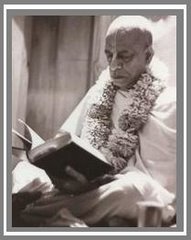
A. As he asked me this question I felt very humbled yet honored and proud to claim a link with the brilliant sun of the Gaudiyas who has illumined the entire world with the light of the Bhagavata, His Divine Grace AC Bhaktivedanta Swami Maharaj.

Q. Why do you call him Swami Maharaj? (Asked in a somewhat challenging spirit)
A. Because he was honored with that name by his Sanyas Guru, Bhakti Prajnana Kesava Goswami. Of course we, his immediate students, addressed him as Prabhupad.

Q. Narayan Maharaj is Kesava's disciple right?
A. Yes

Q. What do you think of him?
A. All I know is that my Guru Maharaj often spoke of him in a very favorable way and Narayan Maharaj even in Prabhupads last moments was there to comfort my Gurudev. If I become disrespectful Prabhupad would be very angry with me because Narayan Maharaja and others are senior to me in many ways . Narayan Maharaj was a life long friend to Prabhupad and was also very instrumental in seeing to the details of Prabhupad's Samadhi.

Q. What about Sridhar Maharaja?
A. Again, Prabhupada saw Sridhar Maharaj as his Siksha Guru. He had great respect for him. If he did then certainly I should.

Q. Govinda Maharaj?
A. Same answer, Prabhupada had great affection for him so why shouldn't I?

Q. I heard Narayan Maharaj and Govinda Maharaj don't see eye to eye on many things and their followers clash all the time.

A. If the question is how do I see these things, here is my answer "Radha's group and Candravali's group clash all the time so what's new? They both have great responsibilities and spiritual ambitions yet they both are pleasing to Sri Krishna. In the spiritual world you won't see clones. Every tree has a different fruit and Sri Krishna tastes each and every one of them".

Q. It seems that they are trying to take devotees away from Iskcon !
A. I don't think Govinda Maharaja or Narayan Maharaja are doing that. The neophyte devotee followers out of affection for whatever camp might knowingly or unknowing be doing so and that creates a backlash of controversy for their guru, unfortunately. Then he has to harmonize all the chaos created by the sectarian views of the neophytes.

Q. Well what about Prabhupads mission?
A. What do you mean?

Q. Didn't Prabhupad tell his student not to mingle with other Gaudiyas?
A. Yes he did. When Prabhupad was on the planet some of his students would go visit other Gaudiya temples learn slokas, mannerisams, drum beats, dialects etc then return to Iskcon and would create havoc by posing as advanced devotees even more advanced then Prabhupad himself.

Prabhupad was always very affectionate toward his disciples and knew that some Gaudiyas did not share Srila Bhaktisiddhantas vision and they would try to inject some negative ideas in the minds of his young and impressionable students. Soon after some of the students left Iskcon and abandoned their Acarya; of course a few stayed.

In my opinion the Mission of His Divine Grace was to fulfill the desire of his Gurudev by living as an example of pure devotion in the western world and making the Holy Name available to all Jeeva souls.

We need to see and hear a living pure devotee so we can transcend all our experimental endeavors to know God.

Q. Well, what about the Ritvik system?
A. When Prabhupad was here with us he had some students act as his representatives to carry out certain activities , all under his immediate direction. After his entering Nitya Leela those circumstances ended. We all agree that His Divine Grace was Shakti AvesA but none the less living examples of Pure Devotion are required and their effulgence should and will be self evident. They cannot be appointed or voted in unless those who elect and appoint are liberated souls themselves; then by all means their instruction should be honored.

Q. Why didn't Prabhupad give Siddha Pranali ?
A. I believe Prabhupad revealed his Spiritual body to a few select devotees who now have a particular type of meditation. Generally speaking though when we are pure of heart and attract Sri Radha and Krishna to ourselves by serving their pure devotees we will be given all these things but we should not be intrusive.

Q. What about Kirtanananda ?
A. His Sukriti was that Prabhupad was concerned about him. Karma-dosaih made him infamous.

Q. What about Prabhupads books ?
A. Everyone can benifit by reading them unless their motive for doing so is to exploit others. In that case they will become more and more entangled in the web of Maya and create a disturbance to the Vaisnava community. Bhaktivinode Thakur has said that even in the midst of such a distrubance : "The Divine Current will never be Obstructed".

Q. So what is your position?
A. All I want to do is continue in this life searching for Sri Krishna and serve the Vaishnavas as best I can. We all are in different situations due to karmic activities so I am just trying to make the best use of a bad bargain.

Q. Well who do you support, Iskcon , Narayana Maharaj, Govinda Maharaj , or ?
A. I am not driven by large buildings, big numbers of people, politics what to speak of an endless system of administration marked by officialism, red tape, and proliferation. Where ever Krishna reveals himself its up to me to be prepared to receive his Darshan. He is not bound by walls, declarations, lofty speeches or mountains of cash. He is bound only by pure devotion. He wiggles here and there like a snake and it's my responsibility to capture him.

Tuesday, July 1, 2008

7 sons of Brahma (Sapta-Rishis)

At the center in the top row sits Jamadagni, with his head thrown back, and his hair reaching his thighs. With the right hand he holds a mala.

Next to him in the clockwise direction is Gautama, clad only in a loin-cloth, with prodigiously long nails. With long hair. He holds his hands above his head, in a tight, clasping posture.

Vashishtha is next, holding in his extended right hand a ceremonial water vessel, his left hand resting on his right knee. He is adorned all over with tulsi beads, including his chest, wrists, upper-arms, and the crown on his head. He sits on a small white prayer mat.

Following Vashishtha is Atri. He chants upon beads held in his right hand that is enclosed in a gomukha-glove (Bead -Bag), and at the same time also holds Rudraksa counter beads in his other hand.

Bhardavaja stands on his head, performing a yogic asana, with his two hands supporting his mortal frame.

Kashyapa hods a coconut shell in his left hand, which holds ritual ashes which he has applied all over his body, and continues to do so on his forehead. He is bare except for a leopard skin covering his genitals.

Last is Vishvamitra, rendered the most elaborate of all. Seated on an antelope skin, he holds in his hands various sacred texts, which also lie by his side. His mouth is bound with a cloth. This probably refers to a long vow of silence this seer is believed to have undertaken.