Even though the following article is not directly related to pure devotional service to the lord ,it is interesting to read. Not a blade of grass move s without the sanction of the Lord.
- AJDTranscendental Supernatural Weapons
The astras are transcendental, supernatural weapons created by the Lord, and presided over by a specific Deity. In order to summon or use an astra, one must have the required knowledge, i.e., the specific mantra that will arm, direct, and disarm the astra. The presiding deity, once properly invoked, endows the weapon, making it essentially impossible for foes to counter its potency through regular means.
As described in sastra, specific conditions existed involving the usage of various astras, and the violation of proper protocol could be fatal. Because of the power involved, the knowledge involving use of an astra was passed from guru to disciple by word of mouth alone, and only the most qualified students were made privy to the information. Certain astras had to be handed down directly from the presiding deity himself, as having knowledge of the mantras alone was insufficient.
The importance of astras is described in particular detail in the Ramayana and Mahabharata, which describes their use in epic battles. Various pastimes describe the use of astras by archers such as Rama, Arjuna, and Bhisma. They generally invoked the astras into arrows, although they could potentially be used with anything. For example, Ashwatthama invoked an astra using a blade of grass as his weapon.
One of the most famous astras is Pashupatastra, being the inconceivably potent and highly destructive personal weapon of Lord Siva. He discharged Pashupatastra by means of his mind, eyes, words, or bow. Never to be used against lesser enemies or by lesser warriors, the Pashupata is capable of destroying creation and vanquishing all beings.
In Mahabharata and Srimad Bhagavatam we also read about the foremost astra, Sri Brahmastra, which will be discussed in tomorrow's segment.
Following are the primary astras mentioned in Ramayana and Mahabharata (Astra, Presiding Deity, Weapon's Effect):
Aindra astra:
Presiding Deity: Indra, the god of weather
Weapon's Effect: Would bring about a shower of arrows from the sky.
Agneya astra:
Presiding Deity: Agni, the god of fire
Weapon's Effect: The weapon discharged would emit flames inextinguishable through normal means.
Varuna astra:
Presiding Deity: Varuna, the god of water
Weapon's Effect: The weapon discharged would release torrential volumes of water. This weapon is commonly mentioned as used to counter the Agneyastra.
Naga astra:
Presiding Deity: The Nagas
Weapon's Effect: The weapon would have an un-erring aim and take on the form of a snake, proving deadly upon impact.
Naga paasha:
Presiding Deity: The Nagas
Weapon's Effect: Upon impact, this weapon would bind the target in coils of living venomous snakes. In the Ramayana, it was used against Lord Rama and Lakshmana by Indrajit.
Vayu astra:
Presiding Deity: Vayu, the god of wind
Weapon's Effect: Bring about a gale capable of lifting armies off the ground.
Surya astra:
Presiding Deity: Surya, the sun god
Weapon's Effect: Create a dazzling light that would dispel any darkness about.
Vajra astra:
Presiding Deity: Indra
Weapon's Effect: Target would be struck with bolts of lightning (vajra referring to Indra's thunderbolt).
Mohini astra:
Presiding Deity: Mohini, Visnu avatar
Weapon's Effect: Dispel any form of maya or sorcery in the vicinity.
Twashtar astra:
Presiding Deity: Twashtri, the heavenly builder
Weapon's Effect: When used against a group of opponents (such as an army), would cause them to mistake each other for enemies and fight each other.
Sammohana/ Pramohana astra:
Presiding Deity:
Weapon's Effect: Would cause entire hosts/armies to collapse in a trance.
Parvata astra:
Presiding Deity:
Weapon's Effect: Would cause a Parvata/mountain to fall on the target from the skies.
Brahmaastra:
Presiding Deity: Brahma, the Creator
Weapon's Effect: Would destroy entire hosts at once. Could also counter most other astras.
Brahmasirsha astra:
Presiding Deity: Brahma, the Creator
Weapon's Effect: Capable of killing devas. Was used by Ashwatthama on Parikshit.
Narayana astra:
Presiding Deity: Visnu, the Preserver
Weapon's Effect: Would create showers of arrows and discs. The astra's power would increase with the resistance offered to it. This weapon had to be obtained from Vishnu directly, and could be used only once.
Vaishnava astra:
Presiding Deity: Visnu, the Preserver
Weapon's Effect: Would destroy target completely, irrespective of target's nature. Infallible. This weapon had to be obtained from Vishnu directly.
Pashupata astra:
Presiding Deity: Shiva, the Destroyer
Weapon's Effect: Would destroy target completely, irrespective of target's nature. Infallible. This weapon had to be obtained from Shiva directly.
The Brahmastra:
As described in the sastra, a Brahmastra is an astra, or celestial weapon created by Lord Brahma. It is sometimes known as the Brahma Astra (astra referring to 'missile weapon'). As described in a number of the Puranas, Brahmastra is considered to be the very deadliest of weapons. When a Brahmastra is discharged, neither a counterattack nor a defense of any kind can stop it.
The Brahmastra never misses its mark and must be used with very specific intent against an enemy, whether an individual or army, as the target will face complete annihilation. Brahmastra is said to be obtained by meditating on Lord Brahma, and can be used only once in a lifetime. The user would have to display immense amounts of mental concentration in order to get sanction to arm and use the weapon. Since Brahma is the Creator in Sanatana Dharma, it is understood that Brahmastra was created by him for the purpose of upholding Dharma and Satya.
According to sastra, the Brahmastra is invoked by a key mantra that is bestowed upon the user when he is given the weapon. By properly chanting the mantra, the user can call upon the weapon and deploy it with annhiliative force against his adversary.
The Brahmastra also causes severe environmental damage. The land where the weapon is used becomes barren for eons, and all life in and around that area ceases to exist. Women and men become infertile. There is severe decrease in rainfall and the land develops cracks, like in a drought.
There are numerous descriptions of weapons created by various demigods, such as the astras and presiding deities mentioned in part one of this review: Agneyastra, Brahmastra, Chakram, Garudastra, Kaumodaki, Narayanastra, Pashupata, Shiva Dhanush, Sudarshana Chakra, Trishul, Vaishnavastra, Varunastra, and Vayavastra. Among them, the Brahmastra is considered to be the most powerful of all.
There are numerous instances found within the Vedic scriptures wherein the Brahmastra is used, or its use is threatened. For example, there is the confrontation of Arjuna and Ashwatthama in Mahabharata, where Arjuna retracts his weapon as ordered, but Ashwatthama, unable to do so, instead sends it to attack Arjuna's unborn grandson, Parikshit, who is subsequently saved by Krishna. Ashwatthama did not have his bow and arrow near him when he was confronted by Arjuna, so he took a piece of grass and after silently invoking the mantra, he threw the straw at Arjuna, and it carried the power of the Brahmastra.
Similarly in the Ramayana, passages describe how the Brahmastra was used by Rama as the final blow against the rakshasa Ravana, during their battle in Lanka.
In the Srimad Bhagavata Mahapurana the following descriptions are given:
Srimad Bhagavatam 1.7.30: "When the rays of the two brahmastras combined, a great circle of fire, like the disc of the sun, covered all outer space and the whole firmament of planets."
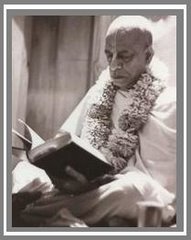
Purport by Srila Prabhupada: "The heat created by the flash of a brahmastra resembles the fire exhibited in the sun globe at the time of cosmic annihilation. The radiation of atomic energy is very insignificant in comparison to the heat produced by a brahmastra. The atomic bomb explosion can at utmost blow up one globe, but the heat produced by the brahmastra can destroy the whole cosmic situation. The comparison is therefore made to the heat at the time of annihilation."
Srimad Bhagavatam 1.7.32: "Thus seeing the disturbance of the general populace and the imminent destruction of the planets, Arjuna at once retracted both brahmastra weapons, as Lord Sri Krishna desired."
Purport by Srila Prabhupada: "The theory that the modern atomic bomb explosions can annihilate the world is childish imagination. First of all, the atomic energy is not powerful enough to destroy the world. And secondly, ultimately it all rests on the supreme will of the Supreme Lord because without His will or sanction nothing can be built up or destroyed. It is foolish also to think that natural laws are ultimately powerful. Material nature’s law works under the direction of the Lord, as confirmed in the Bhagavad-gita. The Lord says there that natural laws work under His supervision. The world can be destroyed only by the will of the Lord and not by the whims of tiny politicians. Lord Sri Krishna desired that the weapons released by both Drauni and Arjuna be withdrawn, and it was carried out by Arjuna at once. Similarly, there are many agents of the all-powerful Lord, and by His will only can one execute what He desires."