Monday, March 31, 2008

Every Saint has a Past
&
Every Sinner has a Future

Sunday, March 30, 2008

We have waited a long time

The human form of life is so rare that demigods (such as Agni, Vayu, Indra) that we hold in high regard and to whom oblations are offered in the yagna, desire to be born human themselves. Everyone knows that the body of a demigod is the topmost out of the 8.400.000 million bodies. Their body exudes fragrance; it is very effulgent and attractive. However, the celestial beings merely reap fruits of previous actions. They do not have the right to perform fruit-bearing actions. God has given the privilege of performing fruit-yielding actions only to humans. Such is the value of the human birth. What this means is that we have waited a long time to become human, and we have undergone great suffering before attaining the human birth through God’s grace.

My Love

In the book of Sri Vrindavana Das Thakur ( Chaitanya Bhagavat), one discovers many detailed descriptions of Nityananda Prabhu and Chaitanya Mahaprabhu that do not seem to be elaborately depicted elsewhere.

Here is one such story.

"My love for kadamba flowers is very great. I always reside in a forest of kadamba flowers". CB 278

One day Nityananda Prabhu asked Raghava Pandit for a garland of kadamba flowers. Sorrowfully, Raghava folded his hands and replied, "This is not the season. There are no kadamba flowers to be found anywhere!" Nitai smiled and said, "Just search carefully around the house. Perhaps you will find some blooming somewhere!"

Raghava Pandit began to search. To his amazement, the lime tree in his courtyard was covered with freshly-blossomed kadamba flowers! When he saw those flowers, Raghava was filled with joy and lost external consciousness. Then, collecting himself, he gathered some of those kadamba flowers and strung a beautiful garland. As he presented that miraculous garland to Nitai Chand, everyone swam in bliss.

Saturday, March 29, 2008

The Holy Fig Tree

The concept of divinity even in vegetation, trees etc has been prevalent in Vedic civilization since time immemorial and have been accepted as a tradition.

Lord Sri Krishna said to Arjuna: "Of all trees I am the holy fig tree, and among sages and demigods I am Narada. Of the singers of the gods [Gandharvas] I am Citraratha, and among perfected beings I am the sage Kapila". Geeta 10.26

The five-trees (Pancha-vat) are considered as very sacred in India, they are:

1. Fig tree,
2. A wild fig (Sycamore) tree (Gular),
3. Banyan tree,
4. Pakar (citron-leaved), Indian fig tree,
5. Mango tree.

Among these the holy fig tree is considered as the most sacred.

A man who plants this tree goes to the abode of almighty God after his death. He can neither be tormented by the miseries of 'Yama-loka' nor has to face miseries in this world.

Lord Vishnu dwells in the roots of this tree, 'Keshav' (Krishna) in the trunk, Narayana dwells in the branches, Lord Shri Hari in the leaves and all the deities dwell in the fruits of the holy fig tree. This tree is the personification of Lord Vishnu. Great men serve the 'Virtuous roots of this tree.

Protection of this tree liberates a man from all his sins and help in the accomplishment of every desire.The cutting of a holy fig tree without a proper reason is similar to cutting one's own ancestors. By doing this, one destroys his descent. But cutting of this tree for sacred activities like 'Yagya' (sacrificial fire) is not sinful, on the contrary it helps in the attainment of Heaven. The mere worship of this tree is worship of all the deities. (Parikrama) moving around a holy fig tree is reverence and pouring water on it daily destroy all kinds of inauspiciousness. Pouring water on the roots of this tree in the month of May (Vaishakh) gives immense virtues, thus worshipping it with devotion gives long life.There is a rule of making three circumambulations of a holy fig tree. Planting this tree on any auspicious day one should nurture it with water for eight years, just like his own son. After that, performing the sacred-thread (yagyopavita) ceremony of this tree and worshipping it with proper methods give undiminishing wealth and fortune, the lineage continues without any hitch, gives long life, and the dead ancestors attain salvation by getting liberation from hell. Hindu girls perform many fasts connected with this tree right from their childhood. A girl who has a probability of becoming a widow according to the inauspicious combination of planets in her horoscope must worship the holy fig tree. After taking bath she should purify the soil around the holy fig tree by cow dung paste, decorate the tree with threads and Ochre and worship it with the help of a Brahmin. She should invocate Lord Vishnu and Laxmi who dwell in the holy fig tree and worship them by chanting 'Purusukta' Mantras and by performing "Havana' and 'Tarpana'. After that she should circumambulate the holy fig tree for 108 times and tie a white thread around it.

The holy fig tree has medicinal properties too. According to Ayurveda this tree has both sweet and bitter taste and has a cool property. Intaking the bark, fruit and buds with different Combination of things cures the diseases related with Phlegm, bile, inflammation swelling and indisposition etc. The soft bark and the bud of this tree cures 'Prameha' (a disease in which sperms emanate through urine).The powdered form of the fruit of this tree increases appetite and cures numerous diseases. So the holy fig tree holds a very important place in Vedic civilization i.e. religious point of view, medicinal and social point of views, and hence it is worth being worshipped.

Friday, March 28, 2008

Krishna said to Arjuna

"Foods in the mode of goodness increase the duration of life, purify one's existence and give strength, health, happiness and satisfaction. Such nourishing foods are sweet, juicy, fattening and palatable. Foods that are too bitter, too sour, salty, pungent, dry and hot, are liked by people in the modes of passion. Such foods cause pain, distress, and disease. Food cooked more than three hours before being eaten, which is tasteless, stale, putrid, decomposed and unclean, is food liked by people in the mode of ignorance".

Thursday, March 27, 2008

"Knowledge which is not firmly rooted is lost, hearing is lost when one is inattentive, advise is lost by doubting it, and japa is lost through a restless mind." -Padma purana

Kunjera-leela

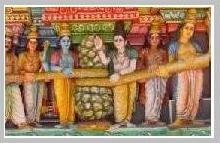
The gopis arranged themselves in the form of an elephant at this location (kunjera), and Krishna climbed upon them. This place is also known as Kunjera on account of this playful event ( Kunjera-leela )

This pastime was performed south west of Radha Kund at Navagram. The boundary of the kunjas of Radha kund begin here. Navagram also received its name "Kunjera" because of its many kunjas.