Wednesday, April 11, 2012

A low class mentality


Written by Srila Bhaktisiddhanta Saraswati Thakur Prabhupada

Many people consider Ekalavya’s 'guru-bhakti' to be ideal, but there is a unique deliberation concerning this topic.

King Hiranyadhanu's son was named Ekalavya. Ekalavya was, by caste, a nisadha (candala). In order to learn astra-vidya, Prince Ekalavya approached Dronacarya. Because Ekalavya possessed a low class mentality, the acarya refused to initiate him in the teachings of the Dhanur-Veda. However, Ekalavya was determined to learn the martial arts from Dronacarya and went off into the forest. There he constructed an idol of Dronacarya made of clay and by continuously practicing in front of that artificial guru he became very expert in astra-vidya.

Arjuna was Dronacarya's most beloved disciple. The acarya had told Arjuna that none of Dronacarya's disciples would ever be able to excel Arjuna in skill.

One day Dronacarya instructed the Kauravas and the Pandavas to leave the royal capital and go to the forest for hunting. As they made their way through the forest, they saw a dog whose mouth had been blocked with seven arrows. Seeing this, they were most astonished. Whoever had shot these arrows was far more expert than the Pandavas. Realizing this, they went in search of that person. Gradually they understood that it was Ekalavya, the son of Hiranyadhanu, who had tested his archery skills on the dog's mouth.

The Pandavas returned to the capital and, approaching Dronacarya, submitted this unusual story to him. With a mood of humility, Arjuna told Dronacarya that it seemed that he had another disciple who was more expert in archery than Arjuna. Dronacarya listened to these words and was surprised. He went with Arjuna into the forest and there they saw Ekalavya continuously shooting arrows like rain, fully absorbed in the science of archery.

Taking the opportunity Dronacarya came forward and approached Ekalavya, and seeing the acarya, Ekalavya immediately offered his prayers at his feet, and with folded hands he introduced himself as his disciple and remained standing. Dronacarya told Ekalavya, "You must give guru-daksina."

Ekalavya replied, "Please tell me – whatever it is, I am ready to give it!"

Then Dronacarya told Ekalavya to cut off his thumb and give him that as his guru-daksina. Ekalavya executed the order of his Gurudeva. Ekalavya did not protest in any way and unhesitatingly executed his guru's instruction.

Initially Ekalavya's guru rejected him because he considered him to be born of a low caste, yet due to his faith in Dronacarya, he established a clay deity of him and became invincible – thus his guru-bhakti was established as ideal. On the other hand, Arjuna was envious towards Ekalavya, because by his perseverance, Ekalavya had become expert; therefore Ekalavya was ruined by Dronacarya – this is the common opinion.

But this is not the opinion of the devotees, nor is it a true conception. Everything about Bhagavan is supremely true, everything about the principles of devotion are supremely true and everything in relation to the devotee is supremely true. These are the three truths – Bhagavan, bhakti and bhakta. Everything a devotee does is good; everything a non-devotee does is not very good. The non-devotee has many bad qualities because he is not engaged in satisfying the senses of Bhagavan. Those that think that mundane laws are greater than Bhagavan cannot accommodate those words regarding the supreme truth. Such persons are nirvisesavadis (impersonalists) which is to say that they cannot accept the non-differentiated specialty of Bhagavan, bhakti and bhakta.

What was Ekalavya’s fault? This analysis is essential. He wore the mask of guru-bhakti, yet he was actually inimical towards his guru. Whether his guru actually considered Ekalavya to be disqualified by his low-birth, or was simply testing him — whatever the reason may be, when his Gurudeva did not wish to teach him the science of warfare, it was Ekalavya’s duty to accept his guru's instruction upon his head; but Ekalavya did not accept that. He had the aspiration to become great.

Externally, without a guru, his practices would not have been considered lawful, or he would not be in a favorable position to become great without accepting a guru. To this end, Ekalavya concocted a clay form of his 'guru'. He only did this to attain greatness by learning the Dhanur-veda. In this way, his main intention was to satisfy his own senses. He did not offer himself as a sacrifice to his guru's desire and his own intentions were not sincere. Some may say that ultimately Ekalavya happily accepted the heartless order of his guru without protest, but if we consider this topic deeply and with keen discernment, we can observe that Ekalavya considered mundane morality to be superior to transcendental devotion. When the guru requests something to be given as daksina, then one must offer it to him – it was that sense of morality that inspired him to cut off his thumb. Ekalavya did not offer it with spontaneous devotion. The very nature of bhakti is that it is spontaneous and simple.

If Ekalavya had unmotivated and natural devotion within his heart towards Hari, Guru and Vaisnava, then the guru, Dronacarya, the best of Vaisnavas, Arjuna, and Bhagavan Sri Krsna, would not have been displeased with his behavior. Ekalavya’s attempt to learn the Dhanur-veda and his hankering to become great were not accepted by his Gurudeva. Deep within Ekalavya’s heart, he desired to try and become greater than Arjuna, the best of Vaisnavas. The aspiration to become greater than the Vaisnavas is not devotion – it is anti-devotional and it is the dharma of the Ativadis (1). According to worldly considerations, the desire to become great is regarded as good. But the effort to take a subordinate position behind a Vaisnava and the attempt to take shelter of a Vaisnava – that is bhakti.

Ekalavya wanted his expertise to be greater than that which could be acquired by learning Vedic sciences directly from a mahanta-guru – Arjuna notified Dronacarya of this. If Arjuna had not mercifully pointed this out, then the victory of impersonalism would have been proclaimed extensively. People would not have approached a mahanta-guru to accept any type of knowledge; they would have desired to create their own contradictory, concocted, clay, lifeless gurus in order to learn various sciences or devotional teachings. In this way, atheistic theories would have been established. Therefore, Arjuna had no envy towards Ekalavya; it was actually his causeless compassion towards Ekalavya and the world.

If Ekalavya had been an honest devotee of his guru, then Krsna would not have killed such a guru-bhakta – He always protects His devotees. But finally Ekalavya was killed by the hand of Krsna. This is how Ekalavya finally met his end (3).

Sri Caitanyadeva has said that we cannot judge devotion simply on the basis of external austerities. The asuras perform penances that even the demigods cannot perform (2). Against the wishes of his guru, Ekalavya wanted to become greater than the Vaisnava. Therefore he was killed by Krsna and attained impersonal liberation. Asuras are always killed by Krsna and the devotees of the Lord are protected by Krsna (4). The proof of this is Hiranyakasipu and Prahlada. Thus we should never attempt to become greater than the Vaisnavas. If we do not wear a mask of guru-bhakti, we will never become impersonalists. This is what the pure devotees have taught in relation to the narrative of Ekalavya. Expertise in performing mundane activities is not guru-bhakti. Taking shelter of the Vaisnavas is actually true devotion.

(From Upakhyane Upadesa, Vol. 2)

FOOTNOTES:

(1) The Ativadis are an apasampradaya that originated in Orissa under one Jagannatha Dasa during the time of Mahaprabhu. The word 'ativadi' means 'one who thinks he is very inteligent' (ati – very, vadi – intelligent).

(2) Ekalavya’s demise is found in Chapter 48 of the Udyoga-parva of Mahabharata wherein Krsna kills him as He battles with Jarasandha’s army.

(3) asure o tapa kare, ki haya tahara vine mora sarana laile nahi para (Cb. Madhya 23.46)

(4) Madhvacarya, in his Mahabharata Tataparya Nirnaya has commented that Ekalavya was the amsa of the demon Manimanta.

yuddhva ciram rana mukhe bhagavat sutah asau cakre nirayudham amum sthiram ekalavyam amsena yo bhuvam agat maniman iti sma sa krodha tantraka ganesu adhipo nisadah

Fighting for a long time with Ekalavya, who was steadfast in battlefield, Pradyumna rendered him weaponless. Previously there was a group of demons known as the Krodha-tantra-ganas, amongst whom there was a prominent demon named Manimanta. Ekalavya is the amsa of that Manimanta.

Sunday, February 12, 2012

A few interesting notes

**************************************

The Veda in its original Sanskrit form deliberates on 130 branches of knowledge. 15 remain on earth today.

The Mahabharata was presented in its original 100,000 Sanskrit verses by Srila Vyasa.

The Bhagavat Gita which is within Mahabharata contains 700 Sanskrit verses.

Sunday, January 29, 2012

Personalities mentioned in the Mahabharata

*********
One of the greatest literary contributions the world has ever known came from the memory Vyasa. Vyasa was not completely satisfied when he completed the Mahabharata so he went on to present the Srimad Bhagavatam.

One reason of his sadness was Sri Krishna's most intimated devotees and their pure devotional service ( Prema Bhakti ) remained obscured.

When the earth became overwhelmed with demonic persons, she could not bare it any longer. She went to The Creator of the worlds (Lord Brahma) and pleaded her case. They then went to the Supreme lord and were told that he would descend on earth in his original two armed form as Sri Krishna to eliminated the burden of the earth. At the Supreme lord's request the controlling Deities (Demigods) appeared on earth in different royal families. Sinful persons had already spread in large numbers through out the earth.

What follows is a list of personalities mentioned in both Mahabharata and Srimad Bhagavatam. Some are Demigods (Divine Personalities) and some are Demons (Sinful personalities).

Both Groups had Mystic abilities and battled each other on this very planet. Srila Vyasa tells a story related to each one of the following characters.

  • The story of Abhimanyu
  • The story of Ahilawata
  • The story of Amba
  • The story of Ambalika
  • The story of Ambika
  • The story of Arjuna
  • The story of Ashwatthama
  • The story of Babruvahana
  • The story of Barbarika
  • The story of Bhima
  • The Story of Bhishma
  • The story of Chitrangada
  • The story of Chitrangadaa (wife of Arjuna)
  • The story of Dhristadyumna
  • The story of Dhritarashtra
  • The story of Draupadi
  • The story of Drona (Dronacharya)
  • The story of Duhsala
  • The story of Duryodhana
  • The story of Dushasana
  • The story of Ekalavya
  • The story of Gandhari
  • The story of Ghatotkacha
  • The story of Hidimbi
  • The story of Iravan
  • The story of Janamejaya
  • The story of Jarasandha
  • The story of Karna
  • The story of Kripa
  • The story of Kritavarma
  • The story of Kunti
  • The story of Madri
  • The story of Nakula
  • The story of Pandu, father of Pandavas
  • The story of Parikshit
  • The story of Sahadeva
  • The story of Sanjaya
  • The story of Satyaki (Yuyudhana)
  • The story of Satyavati
  • The story of Shakuni
  • The story of Shalya
  • The story of Shantanu
  • The story of Shikandi
  • The story of Subhadra
  • The story of Uloochi (or Uloopi)
  • The story of Uttara (wife of Abimanyu)
  • The story of Vichitravirya
  • The story of Vidura
  • The story of Virata
  • The story of Yudhisthira (Dharmaraja)
  • The story of Yuyutsu

Sunday, November 13, 2011

The fact is

The fact is that my native land is a prey to barbarism, that in it men's only God is their belly, that they live only for the present, and that the richer a man is the holier he is held to be.

-Saint Jerome

Wednesday, November 2, 2011

Lord krishna told him

Meenakshi Sinha, Bharatpur, : He stumbles and stoops, trying to get his footing right. But when he greets the audience, his voice is thunderous – “Hare Krishna Hare Ram, sabko meri Ram Ram.”

At 108 years, Nemi Baba is the oldest active Rajasthani folk musician. He plays the algoza, a wind instrument that resembles a pair of wooden flutes. With three fingers on each side of the flute and by breathing rapidly into it, the instrument emits a bouncing, swinging rhythm.

Though speculations about his age abound, Nemi, who seems to have no real idea about it, claims he’s been playing the algoza for 110 years. “He believes it. His sons believe it,” says Divya Bhatia, director of Rajasthan International Folk Festival (RIFF). “Whatever be his age, for me the artist, the man and the legend are more important. There’s something deeply spiritual about Nemi’s attitude to life.”

When the wrestler-turned-baba was recently introduced at the RIFF at Mehrangarh Fort in Jodhpur, he debated for a long time whether to sit or stand even as the audience waited patiently. Then he dropped a bombshell. This would be his last performance here, he said, adding it was because Lord Krishna told him so.

Nemi has a quirky side – he barely smiles but laughs a lot, pounding his chest as if to show that the wrestler in him is still alive. He’s so connected with Krishna that he makes everyone recite a bhajan: “Hare Krishna Hare Ram/teri gele zharu Ram/hamare ghar aao Ram (Dear lord, I’m sweeping my house clean in your name. Do visit my abode).” He claims that regular recitation of it will ward off jealous neighbours.

Krishna could not have had a more devout disciple. At 45 years, Nemi started the parikrama of Braj chaurasi kos from Deeg. This circular journey of some 260km would cover the birthplace of Krishna and touch the districts of Kosi, Nandgram, Barsana, Hodal, Basna, Mathura and Govardhan. “I would complete the journey in six days,” he says. He continued the tradition for 24 years before his health forced him to drop out.

Ask him where he learnt to play the algoza and he recalls Krishna’s raas leela as if he was party to it. “Just like Krishna played the flute among the gopis and his cows, I, too, wandered with my buffalos near the village pond when I was 14 or 15. It was there that I carved the algoza from the trunk of the andara plant (a hollow plant like the bamboo) and have been playing it since.”

The musician, who comes from the Jat stronghold of Bedham in Bharatpur district of Rajasthan, gave up his family and all worldly possessions when he was 55. Since then, he has been living in a small Radha Krishna temple, where he plays the algoza to his lord. He believes he sees the lord in every member of his audience.

While he wandered in the forests and slept in the temple, his wife would visit him to provide food and clothing and to pray together. One day, when she didn’t turn up, he went looking for her at home. She was unwell and resting. Seeing him, she reprimanded him for leaving his prayers incomplete and sent him back. When he returned, she had passed away.

Ask him how he feels today without her and he puts a brave front, but that’s only initially. Biyah kar diyo usne, bida kar diyo. Woh toh kushi kushi gayee apne ghar (“I got her married to the lord and bid her farewell. She went away happily.”) Prod further and he becomes listless. “Don’t ask, sister, how I feel,” he says, adding that he misses the kirtans with his wife. He has two sons and four grandsons.

His longevity could perhaps be attributed to his rich diet. As a wrestler, he would have 7-8 litres of milk daily and 15 litres of pure ghee in a week. Today, he prefers two litres of milk everyday and a meal of chapattis and vegetables. Nand Kishore, his grandon, explains helpfully that Nemi’s generation hardly consumed vegetables . “Most of their food was made up of milk, ghee and sweets.”

Nemi must have eaten well. It still shows, especially when he plays the algoza.

Sunday, September 18, 2011

Jai Sri Radhe

Srimati Radharani

CC Adi lila 4.87:

"krsna vancha purti rupa kare aradhane ataeva radhika nama purane vakhane"

Her worship (aradhana) consists of fulfilling the desires of Lord Krsna. Therefore the Puranas call Her Radhika.

His Divine Grace, Srila A.C. Bhaktivedanta Swami Prahbupada, on Radhastami, September 18, 1969, in London spoke the following:

"So what is the position of Srimati Radharani? We should try to understand this day and offer our obeisances to Radharani. Radhe vrndavanesvari.

tapta-kancana-gaurangi radhe vrndavanesvari
vrsabhanu-sute devi pranamami hari-priye

Our business is "Radharani, You are so dear to Krsna. So we offer our respectful obeisances unto You."

tapta-kancana-gaurangi radhe vrndavanesvari
vrsabhanu-sute devi pranamami hari-priye

Radharani is hari-priya, very dear to Krsna. So if we approach Krsna through Radharani, through the mercy of Radharani, then it becomes very easy. If Radharani recommends that "This devotee is very nice," then Krsna immediately accepts, however fool I may be. Because it is recommended by Radharani, Krsna accepts. Therefore in Vrndavana you'll find all the devotees, they're chanting more Radharani's name than Krsna's. Wherever you'll go, you'll find the devotees are addressing, "Jaya Radhe." You'll find still in Vrndavana. They are glorifying Radharani. They're more interested, worshiping Radharani. Because however fallen I may be, if some way or other I can please Radharani, then it is very easy for me to understand Krsna. Otherwise, manusyanam sahasresu kascid yatati siddhaye yatatam api siddhanam kascid vetti mam tattvatah (Bg. 7.3)

If you go by the speculative process to understand Krsna, it will take many, many lives. But if you take devotional service, just try to please Radharani, and Krsna will be gotten very easily. Because Radharani can deliver Krsna. She is so great devotee, the emblem of maha-bhagavata. Even Krsna cannot understand what is Radharani's quality. Even Krsna, although He says vedaham samatitani, "I know everything," still, He fails to understand Radharani. Radharani is so great. He says that... Actually, Krsna knows everything. In order to understand Radharani, Krsna accepted the position of Radharani. Krsna wanted to understand the potency of Radharani. Krsna thought that "I am full. I am complete in every respect, but still, I want to understand Radharani. Why?" This propensity made Krsna obliged to accept the propensities of Radharani, to understand Krsna, Himself.

These are, of course, very transcendental, great science. One who is advanced in Krsna consciousness and well conversant with the sastras, they can understand. But still, we can discuss from the sastra. When Krsna wanted to understand Himself, He took the tendency of Srimati Radharani. And that is Caitanya Mahaprabhu. Radha-bhava-dyuti-suvalitam. Caitanya Mahaprabhu is Krsna, but He has accepted the propensities of Radharani. As Radharani is always in feelings of separation of Krsna, similarly, in the position of Radharani, Lord Caitanya was feeling separation of Krsna. That is the teachings of Lord Caitanya, feelings of separation, not meeting. The process of devotional service taught by Caitanya Mahaprabhu and His disciplic succession is how to feel separation from Krsna. That is Radharani's position, always feeling the separation. "

The 25 qualities of Srimati Radharani by which She captures Krsna:

1) She is sweetness personified.

2) She is a fresh young girl.

3) Her eyes are always moving.

4) She is always brightly smiling.

5) She possesses all auspicious marks on Her body.

6) She can agitate Krsna by the flavor of Her person.

7) She is expert in the art of singing.

8) She can speak very nicely and sweetly.

9) She is expert in presenting feminine attractions.

10) She is modest and gentle.

11) She is always very merciful.

12) She is transcendentally cunning.

13) She knows how to dress nicely.

14) She is always shy.

15) She is always respectful.

16) She is always patient.

17) She is very grave.

18) She is enjoyed by Krsna.

19) She is always situated on the highest devotional platform.

20) She is the abode of love of the residents of Gokula.

21) She can give shelter to all kinds of devotees.

22) She is always affectionate to superiors and inferiors.

23) She is the greatest amongst Krsna's girlfriends.

24) She is obliged by the dealings of Her associates.

25) She always keeps Krsna under Her control.

On pg 175 in "Nectar of Devotion," Srila Prabhupada writes, "A person who is unable to bear another's distress is called compassionate...Actually, because Krsna is the Supreme Personality of Godhead, it is very difficult to approach Him. But the devotees, taking advantage of His compassionate nature, which is represented by Radharani, always pray to Radharani for Krsna's compassion."

Sunday, September 11, 2011

Distributing Ecstacy

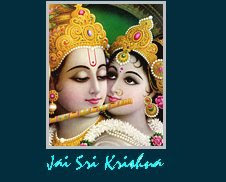
Sri Radhika (Hladini Shakti) and Sri Krishna

The very nature of Krishna has been described as "Ecstasy Himself." He is tasting the innate ecstasy of Himself. He knows His ecstasy and He feels it, but to distribute that innate ecstasy outside, a particular potency is indispensable, and that is known as
hladini. The gist of hladini-shakti, or Krishna's internal ecstasy potency, is Radhika, who is drawing the innermost rasa, the ecstasy of the highest order, extracting it from within and distributing it outsid
e.