Sunday, July 29, 2012

The concept of matter and antimatter

The following is from the book Easy journey to other planets
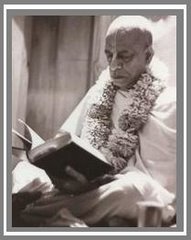
 by A.C Bhaktivedanta Swami
The most widely recognized scriptures in the world are the Vedas. The Vedas have been divided into four parts: Sāma, Yajur, Ṛg and Atharva. The subject matter of the Vedas is very difficult for a man of ordinary understanding. For elucidation, the four Vedas are explained in the historical epic called the Mahābhārata and in eighteen Purāṇas.The Rāmāyaṇa is also a historical epic which contains all the necessary information from theVedas. So the four Vedas, the original Rāmāyaṇa by Vālmīki, the Mahābhārata and the Purāṇas are classified as Vedic literatures. The Upaniṣads are parts of the four Vedas, and the Vedānta-sūtras represent the cream of the Vedas. To summarize all these Vedic literatures, the Bhagavad-gītā is accepted as the essence of all Upaniṣads and the preliminary explanation of the Vedānta-sūtras. One may then conclude that from the Bhagavad-gītā alone one can have the essence of the Vedas, for it is spoken by Lord Śrī Kṛṣṇa, the Supreme Personality of Godhead, who descends upon this material world from the anti-material world in order to give complete information of the superior form of energy.
The superior form of energy of the Personality of Godhead is described in the Bhagavad-gītā as parā prakṛti. The scientists have recently discovered that there are two forms of perishable matter, but the Bhagavad-gītā describes most perfectly the concept of matter and antimatter in terms of two forms of energy. Matter is an energy which creates the material world, and the same energy, in its superior form, also creates the anti-material (transcendental) world. The living entities belong to the category of superior energy. The inferior energy, or material energy, is called aparā prakṛti. In the Bhagavad-gītā the creative energy is thus presented in two forms, namely aparā and parā prakṛti.
Matter itself has no creative power. When it is manipulated by the living energy, material things are produced. Matter in its crude form is therefore the latent energy of the Supreme Being. Whenever we think of energy, it is natural that we think of the source of energy. For example, when we think of electrical energy, we simultaneously think of the powerhouse where it is generated. Energy is not self-sufficient. It is under the control of a superior living being. For example, fire is the source of two other energies, namely light and heat. Light and heat have no independent existence outside of fire. Similarly, the inferior and superior energies are derived from a source, which one may call by any name. That source of energy must be a living being with full sense of everything. That supreme living being is the Personality of Godhead, Śrī Kṛṣṇa, or the all-attractive living being.

Sunday, July 8, 2012

Intense Devotion

One can see enlightenment among the elderly at pilgrimage sites in India, especially in Vṛndāvana. There one sees many old people visiting temples with intense devotion early in the morning. Hundreds of old people walk the circumambulation (parikrama) paths despite physical debilities. Some are bent nearly double! Someone might criticize that these people are not being provided with the Western medical treatment that could add a few years to their lives or ease their pain. But the sincere bābājīs and widows of Vṛndāvana who somehow make their way every morning to see Kṛṣṇa in the temples and who call out "Jaya Rādhe!" are actually fortunate and most intelligent. They are taking the kṛṣṇa-rasāyana, the elixir that will grant them eternal life in Kṛṣṇa's spiritual abode. The Vedic śāstras recommend that one drink this elixir from the beginning of life, but even if one neglects to do so earlier, one should by all means drink it during the waning days of life and thus cure the disease of repeated birth and death.

Wednesday, July 4, 2012

Puzzled

Historians and philosophers have long puzzled over the meaning of life to no avail. But we have nothing to profit from their imaginary explanations which cannot give us any relief from the miseries of the world. The self-realized soul can understand how conditional life is non-cooperation with Krishna.

Some good Souls

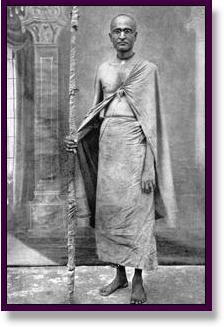
Our Guru Maharaja injected his Spiritual Vision in some of us, and the work is continuing in different branches, as fast as possible by Bon Maharaja, Tirtha Maharaja, my humble self and others. Similarly in the Western world, Krishna has sent me some good souls like you, and I hope, even in my absence, that the spirit of Krishna Consciousness will be spread
Srila A.C. Bhaktivedanta Swami

Thursday, June 21, 2012

Bitten by the snake

Be kind, O blissful one. Be kind, O Supreme Lord. O Lord, please rescue me, bitten by the snake of physical and mental pain. O Krishna, O husband of Rukmini, O enchanter of the gopis, O master of the universe, please rescue me, drowning in the ocean of repeated birth and death. O Kesava, O Narayana, O Govinda, O Janardana, O source of all transcendental happiness, O Lord who rescues your devotees from distress, O Madhava, please rescue me.

Brahma said: As I worship Him, so should you. Chanting this five-word mantra ("klim krishnaya govindaya gopijanavallabhaya svaha") , and meditating on Lord Krishna, you will transcend the world of birth and death. One who chants this five-word mantra easily attains His transcendental abode. Although fixed in His abode, the Personality of Godhead is swifter than the mind and can overcome all others running. Even the powerful demigods cannot approach Him. Therefore, Krishna is the Supreme Personality of Godhead. One should meditate upon Him, glorify Him, serve Him and Adore Him with a devoted heart.
Vyadhi, or physical pain, inevitably comes when one fulfils his material desires. When material desires remain unfulfilled, however, the conditioned soul experiences mental pain, or adhi. Either condition is inauspicious for the conditioned soul.

In the Hari-vamsa, Lord Shiva explains the meaning of the name Kesava: "Both Brahma (ka) and I (isa), the master of all living entities, were born from You, and for this reason, O Lord, You are known as Kesava."


Saturday, June 16, 2012

Happy father's day

Then again, it was confirmed by Kṛṣṇa, Vāsudeva. Because a king is representative of God. King is not ordinary person. Just like spiritual master is representative of God, similarly, king is also representative of God. The father is also representative of God. These are the statements of the śāstras. Because they will guide. The king will guide. The spiritual master will guide. The father will guide. What is that guidance? That guidance is how one can become Kṛṣṇa conscious by education, by culture. This is guidance, not that to guide them how to become hippies. This is not guidance. This is misguidance. Guidance means... The whole system of human civilization is guide the people to become God conscious. This is the Vedic civilization, not to make them dog conscious, cat conscious, animal conscious. No.  
Srimad bhagavatam 1.9.49

Sunday, June 10, 2012

A sober person


The word Guru generally means teacher. Of course today there are many different types of teachers. Some teach mundane subjects and others teach the transcendental sciences.  In the Srimad Bhagavatam the heaviest of all teachers "Srila Vyasa" teaches us how to see reality the beautiful (Sri Krishna) in all walks of life. He teaches us how to take lessons from the 24 Gurus mentioned below.

From Srimad Bhagavatam 11.7.33-35 (paraphrased).

The 24 gurus are: the earth, the air, the sky, water, fire, moon, sun, pigeon, python, the sea, the moth, honeybee, elephant and honey thief, the deer, the fish, the prostitute Pingala, the kurara bird, the child, the young girl, arrow maker, serpent, spider and wasp.

1. Earth: a sober person should never be distracted from progress on his won path even if he is harassed by other living beings, because they are acting helplessly under the control of God. He should be as steady as the earth. Like the mountain and the tree, he should dedicate himself to the service of others.

2. Air: a transcendentalist may be surrounded by innumerable material objects possessing good and bad qualities. But like the wind he should never be entangled by them. When the wind carries different aromas, it never mixes with them.

3. Sky: Though the sky extends everywhere and everything rests within it, it does not mix with anything. The soul and Supersoul have the same quality. 

The sky is never implicated or affected by the blowing action of the wind. In the same way the living entity is never affected though it may enter a body of material elements.

4. Water: The saintly person is like water because he is free from all contamination, gentle by nature and when speaking creates a beautiful vibration like the flowing of water. By seeing, touching or hearing such a saintly person, the living entity is cleansed as if coming in contact with pure water.

5. Fire: Even if a saintly person eats contaminated food by chance he is not affected, like the fire that burns up contaminated substances that are offered to it. Like fire, he is sometimes concealed and sometimes revealed. As the spiritual master he burns up the past and future reactions of his disciples. The Supreme Soul is like fire in that He enters different bodies as fire manifests differently in various pieces of wood. Like the flickering fire, the waves of time flow constantly and imperceptibly bring with them birth, growth and death. But just as nobody can follow the changing pattern of a flame, no-one can see the changes wrought by time upon them.

6. Moon: Though the moon waxes and wanes, it is not affected by this "change." Similarly the living entity is not affected by the changes of the body from birth to death.

7. Sun: A saintly person can accept a material thing with his senses and at the appropriate time he gives that thing to the proper person. So also the sun evaporates water and returns it to earth as rain. Sun and saint are never entangled by this. The sun is reflected in many objects but is never divided. Also the soul is reflected into various bodies but is always one and the same.

8. Pigeon: he is an example for excessive attachment, because he chose to be captured by the hunter after seeing his wife and children so captured, thinking that without them life was not worth living.

9. Python: he does not make arrangements for food, but waits for food to come to him. This exemplifies peacefulness and patience.

10. The sea: just like a tranquil sea, the saintly person, being full of knowledge, is never disturbed.

11. The moth: a foolish man is captivated by a woman's charms just like a moth is captivated by a flame and burns within it.

12. The honeybee: a renounced person who begs a little food from different houses is like a madhukari, or honeybee. Also a honeybee takes nectar from different flowers. So also an intelligent human being takes the essence of different scrip-tures. But a saintly person should not become greedy and collect too much.

13. The elephant: A saintly person should remember how the great bull elephant is captured by the she-elephant; therefore he should never desire to touch the body of a young girl.

14. The honey thief: sannyasis and brahmacaris are entitled to take away the wealth of the laboring householders, just like a hone thief takes away the honey from the nest of the busy bees.

15. The deer: they are bewildered by the sound of a hunter's horn, and thus are killed. A renounced person should never become attracted by mundane sounds like sensuous music, especial-ly the sweet singing and dancing of beautiful women.

16. The fish: they are caught on the hook by their uncontrollable tongues. A learned man should control all his senses by first controlling the tongue, which is the most powerful sense of all.

17. Pingala: this prostitute gave up her plans for earning money through sex indulgence out of frustration. Feeling satisfaction from her abandonment of material desires, she could remember Krsna and became peaceful.

18. The kurara bird (hawk): When a hawk carrying some meat was attacked by larger hawks, he gave it up out of fear for his life. Renouncing and saving himself, he felt more happiness than he did when he took the meat.

19. The child: a foolish child is happy due to ignorance, and a saintly person is happy due to having surrendered to Krsna.

20. The young girl: receiving some prospective bridegrooms on a day when her parents were away from home, she went into the kitchen to prepare food for them. While beating rice, her bracelets jangled, and she was afraid that the young men would think her family was poor because she was doing all the work in the home. She broke all the bracelets except two on each arm, but these also jangled. She then removed one from each arm, leaving only one on each arm. Thereafter she worked in silence. So too, when many people live together, there will be clashing of interests and fighting. It is better to live alone.

21. The arrow maker: the devotee should be so absorbed in the Lord that he does not see duality, just as the arrow maker was so absorbed in his work of making a straight arrow that he did not notice the king passing buy.

22. The snake: he makes no home for himself, but takes over the homes of others, having eaten them. A sage should similarly make no endeavors for his own shelter.

23. The spider: God is like the spider because He creates the network of the cosmos from his own potency and then withdraws it into Himself.

24. The wasp: he trapped a weaker insect in his hive. This insect took on the mentality of a wasp out of intense fear of the wasp, and thus became a wasp in its next life. This illustrates how one attains in the next life what one's mind is fixed upon.